

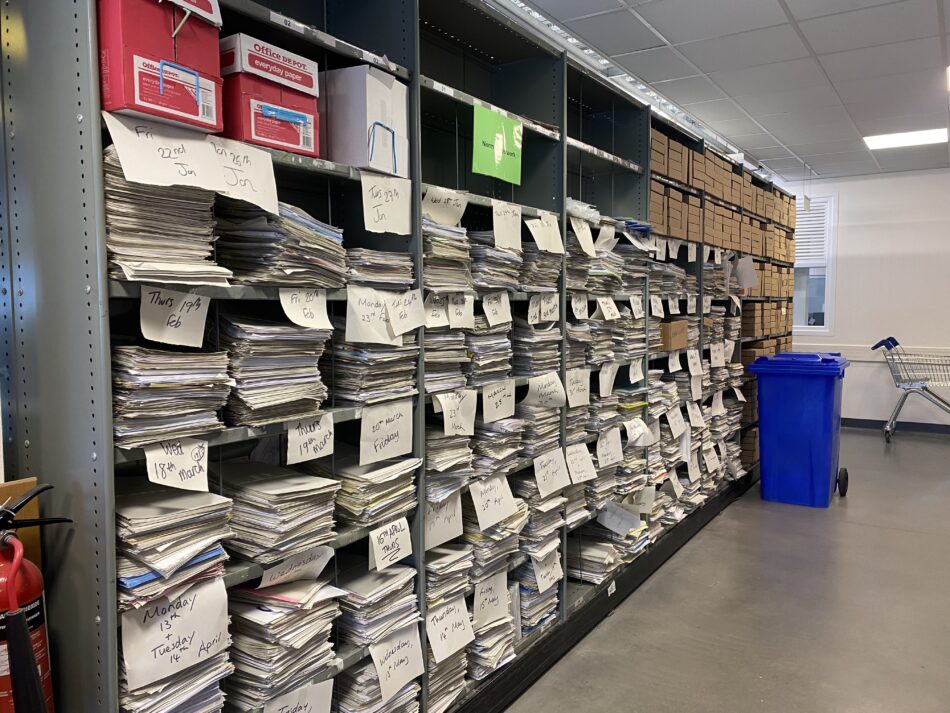
The electronic patient record will replace many paper files
If you work in digital, informatics or data, this is what the new electronic patient record will mean for you.
You’re supporting patient care, often behind the scenes. Perhaps you’re busy in medical records, clinical coding, BI/information services or digital health.
You may be managing the digital systems used for x-rays, CT scans, MRIs or ultrasounds, liaising with radiology departments and IT, working with different systems or matching the right image to the right patient and making sure the right clinician can see it.
Perhaps you’re managing all the detail and complex admin that comes with patient records and documentation, scanning, uploading, checking, preparing, finding, organising and dealing with requests for records.
You may be in clinical coding; translating medical information into NHS codes and making sure our Group’s activity is recorded accurately and consistently. You’re producing high quality data that feeds into our reporting, planning and funding.
Or you’re in digital health, where your work helps to underpin and support the Group’s clinical services.
You may be in core services or cyber security, information governance, training and support. Or your work may involve information services, supporting digital hospital or clinical safety.
For all these roles, the EPR will change how you receive, manage, share and report information.
The EPR will bring a more connected way of working, with one shared record supporting operational processes and reducing much of the duplication you have to manage today.
Changes you may notice
• Faster access to patient information and reduced time spent locating paper notes.
• Less duplication of data entry and fewer manual handoffs between teams.
• More reliable and timely information for reporting, planning, and service oversight.
• Improved data quality thanks to the reduction in the number of different systems and records you need to work with.
• Better support for joined-up working across sites and services.
Medical Records colleagues will see less reliance on paper case notes and more digital record handling, with different processes for filing, tracking and retrieving information. In return, this means easier access to records, less physical filing and improved availability of information when it’s needed.
Clinical Coders will find that coding increasingly relies on information held in the EPR and its supporting documentation, giving clearer access to clinical activity and diagnoses. This supports more complete records for accurate coding and even better coding quality overall.
BI/Information Services will see new reporting structures, data feeds and dashboards as the number of legacy paper-based processes reduce. The payoff is better-quality data for analysis, monitoring and decision-making.
Digital Health teams should expect more configuration, support, training and optimisation work as the EPR goes live and matures, with further improvements and modifications taking place over the coming years.
This will lead to a more integrated digital environment and improved standardisation across the Group.
Why this matters
The EPR is not just a clinical system. It is an operational change that will affect how information is stored and flows through the Group, how services are managed and how data is used for performance, coding and improvement.
What to expect
There will be a new system to learn: Our EPR, supplied by Meditech Expanse, will replace or connect into many of the tools you use now for ordering, results, prescribing and specialist documentation.
Some paper-based tasks will reduce and new digital ways of working will need to be learned and embedded across teams.
Training and preparation: over the coming months you will have time to train and will be shown how to adapt to new workflows, work with different ways of accessing records and use updated processes for handling information. There will be role-specific training tailored for you, teaching you how you will work with the new system. There will be peer support too; colleagues in your area who will be trained to help.
A chance to shape it: the programme is drawing on clinical and non-clinical subject matter experts from across the Group to shape the design and build of our EPR. There will be lots of testing too, and time for feedback from that testing to inform how our EPR will work.
What do I need to do?
• Keep visiting this online change hub for news, updates and information.
• Look out for staff events where you can see the system and speak to the team.
• Be prepared for EPR training and opportunities to practise before the planned move to our EPR at the end of May 2027.
• Make contact with the change team at your Trust if you have any feedback or questions.