
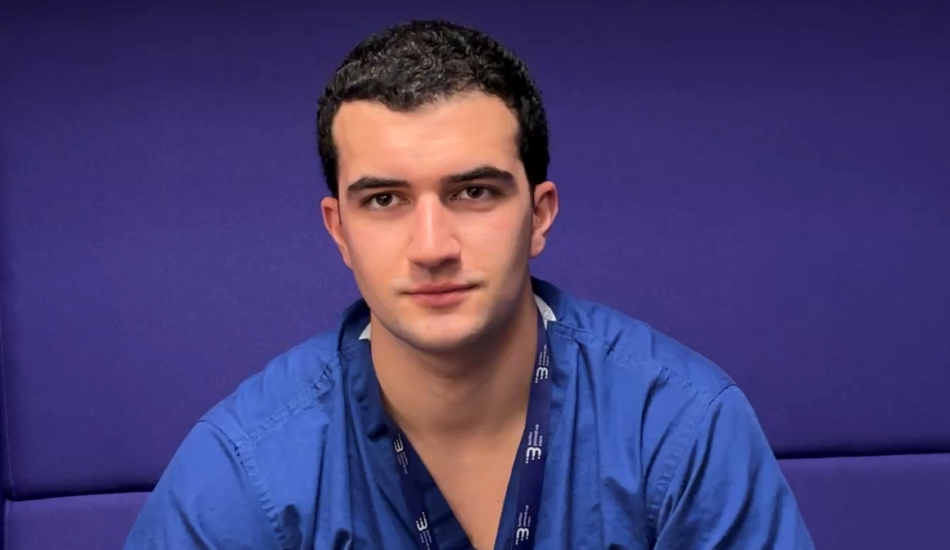
Resident doctor Dr Georgios Anastasi
Resident Dr Georgios Anastasi explains some of the changes the EPR will bring for resident doctors.
Dr Georgios Anastasi, Year 2 resident doctor, looks at what our Meditech Expanse EPR will mean for resident doctors and clinical teams across Norfolk and Waveney University Hospitals Group.
Digital is already part of everything we do
“Digital is very important to clinicians. From diagnostics to the specialised technology we use in clinics, it’s used all the time. On the virtual ward we don’t use any paper, and that’s going to become more common across the group,” says Georgios.
He feels staff will embrace the EPR: “You don’t have to understand how a digital system works. You need to know how to use it and how to find what you need.
“If you moved from a hospital that uses paper to one with an EPR, you’d be learning a system that’s new to you. Here, the new system will just be new to everyone,” he says, pointing out that everyone will be taught how to use it before it is implemented.
Handover lists: less time chasing
“Before a ward round, resident doctors prepare a list of all the patients. You might have a spreadsheet and need to check everything on it is accurate. You go to check and some information is missing, or a patient isn’t there because they’ve been moved, and you have to go and find out what happened. Having all the information about each patient available is going to save a lot of time.”
What stays the same?
For Georgios, one of the biggest reassurances is that teamwork stays the same.
“What I like about what’s staying the same is our interactions with other professionals. We’ll still be discussing together the best treatment for patients.
“The way we practise is staying the same, and that’s a good thing. It’s a big change, but the only change is learning a new system. It doesn’t change your medical knowledge, patient safety or your decisions.”
“It’s going to be much easier having one or two tabs open on the screen than flicking through all of them.”
Fewer tabs, less hunting
“When I’m clerking a patient I can have seven or eight tabs open for the different systems I need, and some clinicians have many more depending on what they’re doing. We will have less with the EPR. It’s going to be much easier having one or two tabs open on the screen than clicking through all of them to find things,” says Georgios, pointing out that the EPR will make it possible to see notes from multiple people at the same time.”
Handover lists: less time chasing
“Before a ward round, resident doctors prepare a list of all the patients. You might have a spreadsheet and need to check everything on it is accurate. You go to check and some information is missing, or a patient isn’t there because they’ve been moved, and you have to go and find out what happened. Having all the information about each patient available is going to save a lot of time.”
What stays the same
For Georgios, one of the biggest reassurances is that teamwork stays the same.
“What I like about what’s staying the same is our interactions with other professionals. We’ll still be discussing together the best treatment for patients.
“The way we practise is staying the same, and that’s a good thing. It’s a big change, but the only change is learning a new system. It doesn’t change your medical knowledge, patient safety or your decisions.”
“The EPR should make it possible for consultants on call at home to log in to MEDITECH Expanse when they get a call, see what’s happening with the patient and give initial clinical advice straight away. ”
On call, knowing where to start
Gathering information quickly is always helpful, especially when resident doctors on call need to swiftly build up a picture of the health of different patients.
“If you’re on call and get called to three unwell patients at once, the EPR will show you what’s been happening with each of them, that will help you prioritise.
“When you’re on call, these are very often patients you haven’t seen before. With the EPR we’ll know who has seen them and what the plans have been, which is useful even before you get to the bedside. To have everyone working in one place is going to be amazing.”
“At the moment we can see immediate information like bloods, but if a patient has been in hospital for a few days, you can’t straight away get the documentation from the past couple of days. So you wouldn’t necessarily know if someone was suddenly deteriorating, or had been deteriorating over several days. With the EPR we’ll be able to see how a patient has been over the last two or three days. We will see who is more urgent in that moment.”
“To have everyone working in one place is going to be amazing.”
About Georgios
Georgios has completed rotations including gastroenterology, orthopaedics and general surgery, and is currently based in NNUG digital with the virtual ward and the EPR change team, with paediatrics and vascular surgery rotations to come. He has been working to improve some of the functionality of Alertive and building his knowledge of the EPR so he can share it with colleagues.