
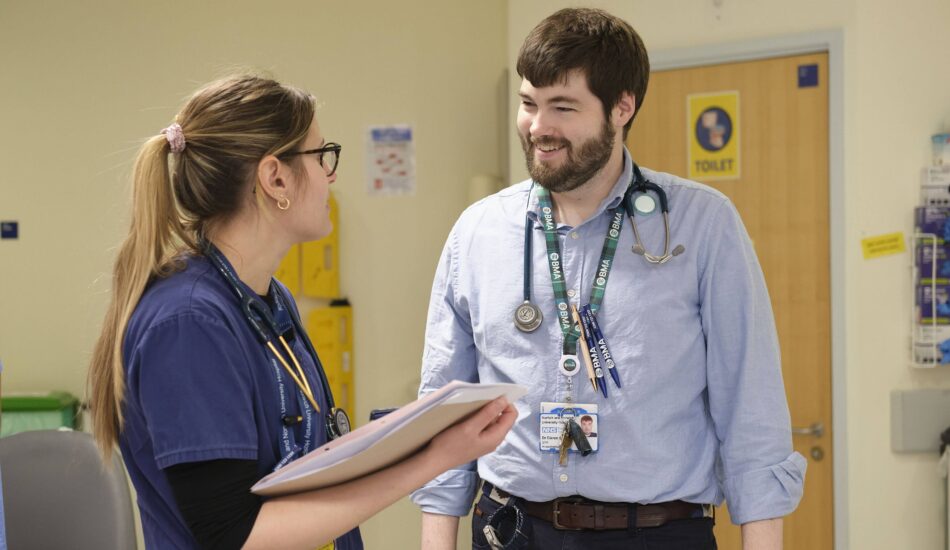
Dr Demetra Kyriakides and Dr Ciaran Scott
How will the EPR change day-to-day work for medical and dental staff?
Less time moving between systems, more time with patients. That’s the change medical and dental staff should notice most.
Right now, information about a single patient can sit across dozens of different systems. Our EPR brings almost all of it together into one record, across all three of our acute hospitals. At go-live, it replaces more than 90 of the systems currently in use, with more to follow in later years.
What this means day to day
Information will be easier to find, so decisions can be made with the full picture in view. Coordination between specialties should improve too, since everyone is working from the same record rather than piecing information together from different places.
Standardised processes across the Group will also replace a lot of local variation. That should mean less duplication and fewer workarounds for staff who currently have to bridge the gaps between systems themselves.
Is the EPR replacing every system?
No, not at first. Some specialist systems, in areas like radiology, laboratories, critical care, endoscopy and ophthalmology, aren’t being replaced straight away. Instead, they’re being connected into the EPR, so they keep doing the specialist job they already do well, while sharing information with the wider patient record. The change hub has an up-to-date list of what’s being replaced and what’s staying connected.
For consultants and dentists
The EPR gives a complete, longitudinal view of each patient’s health journey, which supports medical decision-making and reduces the risk that information is incomplete. Shared medical standards across the Group should also help deliver more coordinated care across specialties.